Consuming a REST Service
Payara
A REST Service in Java EE can be created using JAX-RS. The contents of such service can be consumed using ordinary HTTP requests to a URL. URLs are typically kept simple and have a logical pattern, so it’s easy to type them manually in e.g. a browser. This is different from SOAP, which essentially uses HTTP as well, but is designed to be rather complex and therefor making it not so easy to quickly test something in a browser.
There is a very large number of tools that allow us to request a URL and see its response. Among the more popular ones are:
For our first example we’ll be demonstrating how to consume a REST service via a browser.
We’ll start with defining the REST Service (JAX-RS resource) itself as follows:
@Path("/resource")
@Produces(TEXT_PLAIN)
public class Resource {

    @GET
    @Path("hi")
    public String hi() {
       return "hi!";
    }

}
Next we'll create an activator class that activates JAX-RS itself:
@ApplicationPath("/rest")
public class JaxRsActivator extends Application {

}
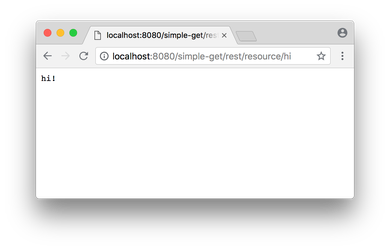
When we bundle this together into a war called “simple-get” and deploy it to a default Payara server instance, we can request http://localhost:8080/simple-get/rest/resource/hi and the browser will respond with rendering “hi!”:
When using the command line, we can use the wget command to achieve consume the REST Service. This can be done as follows:
wget -S -O - http://localhost:8080/simple-get/rest/resource/hi
This will print something like the following to stdout:
HTTP/1.1 200 OK
  Server: Payara Server  5 #badassfish
  X-Powered-By: Servlet/4.0 JSP/2.3 (Payara Server  5 #badassfish Java/Oracle Corporation/1.8)
  Content-Type: text/plain
  Content-Length: 3
  X-Frame-Options: SAMEORIGIN
hi!
For the next example we’ll be looking at how to consume a rest service programmatically via Java.
From a standalone Java SE application, but also from a Java EE application, this can be done using the JAX-RS Client Builder API as follows:
String response =
    ClientBuilder.newClient()
         .target(
             URI.create(new URL("http://localhost:8080/simple-get/rest/resource/hi").toExternalForm()))
         .request(TEXT_PLAIN)
         .get(String.class);
After executing this code the string “response” will be set to the “hi!” that was returned from our service.
The full source of this application can be found on GitHub, along with an automated tests that demonstrates how the application is supposed to be called:
{{cta(‘2eb9cd6f-9ea8-460c-abb1-ae8655654ba2’)}}
Share:

 1 minute
Earlier this week, we’ve launched the 2026 Payara Platform Community Survey and we’d love to hear from you. If […]
 4 minutes
Strategic acquisition bolsters Azul’s Java platform with complementary products, deep Java expertise and accelerated go-to-market capabilities SUNNYVALE, Calif., and MALVERN, […]
 3 minutes
When legacy systems approach end-of-life (EOL), enterprise IT teams typically face the choice of moving forward at all costs […]